Odors, H2S, pond sludge buildup, FOG in the collection system, and aquatic weeds each trace back to a specific cause. Start from the problem you’re solving and the program narrows to the right product.
More results...
Issues
Subcategories
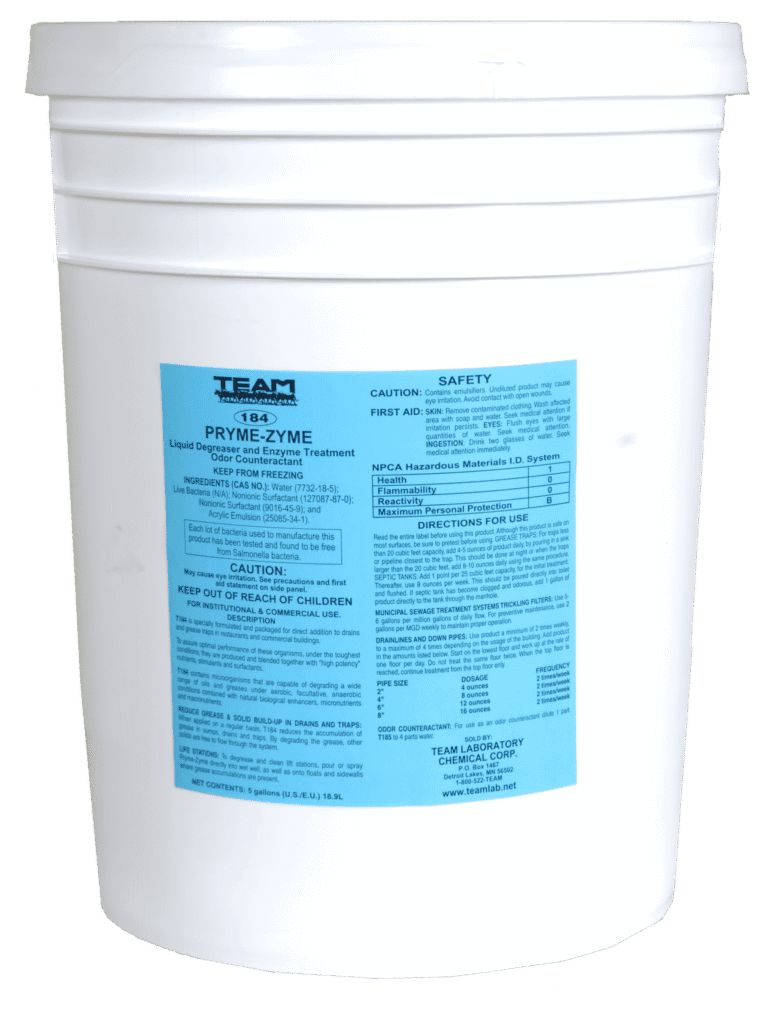
T184Q • Pryme Zyme
Bacterial digestant for restaurant and commercial drains and grease traps.
Bioaugmentation is the use of select microorganisms and specific nutrients to break down complex substances within a waste stream, converting them to simpler particles. By fortifying the population of indigenous bacteria, you can enhance system performance through accelerated waste digestion, improved pollutant reduction and odor mitigation.
Today, we offer a broad portfolio of biological formulations for a wide range of applications including lagoons, activated sludge plants, sequencing batch reactors, rotating biological contactors and collection systems.
Treatment Plants
Ammonia Reducing Bacterial Aid
Anaerobic Digestion Aid
Mechanical Plant Treatment
Stabilization Ponds
Sludge Reduction
Cold-Weather Sludge Reduction
Lift Stations / Collections System
F.O.G. Remediation
Grease Control
+Custom formulas to fit any bioaugmentation needs.+Other bioaugmentation products available
Measured results at named plants
Bongard’s Creameries, Perham, MN. Sludge across two 8.8 acre ponds fell 85 and 77 percent, roughly 9 million gallons digested, avoiding an estimated $998,000 in mechanical removal at $0.11 per gallon.
Grand Marais, MN. Settling improved enough that the plant began decanting waste sludge from the digester for the first time in 26 years. Net savings after product cost: $38,742 in 2018.
See exactly how much sludge is in your pond, and if it is going down.
The hard part of running a stabilization pond is that the sludge is out of sight. Team Lab runs a remote-control boat carrying a GPS-linked sonar across the pond and maps the sludge blanket across the whole surface, not a handful of poked spots
Safer than the old sludge judge method, since people stay off the water for most of the survey.
A full contour map and a real sludge volume, not a few scattered readings.
Repeat surveys show the accumulation rate over time, which is how you monitor whether a bioaugmentation program is working.
The measured volume drops straight into a desludging request for quote when dredging is needed.
336,528 sonar data points on one 5.4-acre pond survey. Mapleton, North Dakota, April 2026.
What causes the rotten-egg odor at our lift station?
Hydrogen sulfide from septic conditions where sulfate-reducing bacteria break down organics without oxygen. Reducing the organic load lowers H2S generation at the source.
Can bioaugmentation reduce how often we dredge a pond?
Yes. Digesting settled solids over a maintenance cycle slows sludge accumulation, which lengthens the interval between dredging events.
Do these products require special equipment to apply?
Most dry blends are added directly on a dosing schedule. Liquid programs may use simple metering at the wet well. Your rep sizes the program to your plant.
Want to know what is really in your pond?
Talk to the territory rep for your state. Tell them what you are seeing in the system and they will work the program with you.